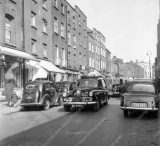
The 17thC street has always been considered the heart of The Liberties
08.05.26
Meath Street was laid out in the late 17th century as a planned residential street, in what was then the domain of the Earls of Meath.
In 1680, a stonemason by the name of Wheeler was commissioned to draw up plans for a new thoroughfare to link Thomas Street with The Coombe. The then-Earl’s intention was to create a spacious and fashionable residential enclave in what was at that time the semi-rural western suburbs of Dublin.
The street measured 44 feet in width at its centre, and originally the street narrowed at its north and south ends on account of existing buildings at either end. Later work by the Wide Streets Commission in the 18th century widened the junction with Thomas Street and left a notable corner building, what is now Baker’s Corner (now Dudley’s Public House). The side streets and lanes off Meath Street developed organically and a map from 1728 shows the area fully urbanised and densely developed – much as it remains today.
The Earl of Meath was not particularly prescriptive in the design of buildings on the street and it is thought that in its earlier years, Meath Street would have been lined with gabled buildings, after the fashion of the time with large chimney stacks punctuating the roofline. Contemporary accounts also point to some buildings with balconies, showing the eclectic mix of styles and foreign influences in the area.
The street almost from the start developed into a thoroughfare of merchant shops with living accommodation above. A concentration of the Quaker community in The Liberties in the early 18th century resulted in businesses such as bookshops, publishing houses and educational establishments. You can still see the remains of the arched entrance to a Quaker meeting house beside Fusco’s at 26-27 Meath Street. The space within, which would have been the entrance vestibule into the meeting house, is now occupied by a small provisions shop.
Some interesting details from a study by AJ Walsh on ‘Meeting Houses of the Religious Society of Friends in Ireland’ (undated):
“In 1684 the large Quaker Meeting House at Meath Place was erected to replace the earlier one at Wormwood Gate, which had become too small. This new Meeting House was erected by friends of the Leinster province by subscriptions taken from all over Ireland. It is interesting to note, however, that even at this early date, Cork friends were showing a spirit of independence which had long characterised them, by objecting to being asked to contribute to the fund.
This Meeting House, although out of Friends’ hands for over twenty years, is still in good order and must be the largest Meeting House ever to be erected by the Society in Ireland. A gallery surrounds three sides and the stand remains on the fourth side. Some pillars incorporated into later walls in the yard show the original entrance to the stables. Although the furnishings are now gone, and the building is used by a silversmith as a workshop, the interior retains much of its former dignity. One noteworthy feature is the presence of a timber ceiling cornice and rather more elaborate panelling than one would expect in such an early Meeting House.”
The Meeting Hall to the rear was demolished as recently as the 1980s.
The initial prosperity of Meath Street didn’t last. By the mid-18th century, many of the thriving industries in the area began to decline dramatically as competition from elsewhere in the city and even from England began to take its toll. The area became increasingly disadvantaged, with poverty and overcrowding becoming rife by the later 18th century and into the 19th. Nevertheless, the street remained a trading street, becoming dominated by household provisions, notably bakeries and dairies. However dereliction set in, particularly along the southern end of the street, and its commercial activity became something of a veneer, masking surrounding slums and deprivation.
The street revived somewhat in the early 20th century with developments of new housing such as the Gray Street scheme by Dublin Artisan Dwellings Co – a scheme supported directly by the Reginald Brabazon, the 12th Earl. Gradually over the 20th century the street lost more and more of its older building stock, with new buildings being usually bland and functional and often single storey in size. Handsome details such as timber shopfronts and joinery were lost, particular from the 1980s onwards.
An intriguing image from the collection of photographer John Walsh shows Meath Street at a crux. The terrace, on the street’s west side looking towards Thomas Street, is lined by handsome Georgian buildings, attractive shopfront and elegant awnings. The scene is 1957 and it can just be imagined that the newer fashions and tastes of the 60s and 70s that are set to change the street more radically, are around the corner.
Today, the street is in need of a new injection of life and vitality. Market life continues but to a much-reduced degree than before 2000. Now almost 340 years old, Meath Street need a new lease of life for the 21st century.
Above is extracted from Dublin Civic Trust’s 2008 Study of the Past, A Vision for the Future: Meath Street & Francis Street and featured as a Facebook post in 2017.
Two images are from the archive of John Walsh “The 50 Francis Street Photographer”, kindly permitted by the John Walsh Archive. The photos capture the funeral of Canon Glesson in 1958, and event that was photographed extensively by John Walsh.
Other images show shopfronts in the early 1980s and are from the Dúchas collections.


