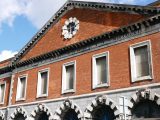
The historic market building is currently undergoing a major restoration of its roof as part of emergency stabilisation work overseen by Dublin City Council
15.10.26
All may seem quiet at the Iveagh Markets from Francis Street, but inside, the building has been transformed by the erection of enormous scaffold decks as part of a major refurbishment of its roof. Work commenced in January 2026 on the second phase of an extensive programme designed to safeguard the building into the future and to hasten its return to public use.
Work has been underway since early summer to remove layers of lead paint from steelwork within both market halls. The work is highly specialised and is being undertaken under very strict control protocols.
Lead-based paints would have been quite usual during the 20th century but they are now generally considered as hazardous and modern health and safety standards require the very careful removal of such paint finishes.
The smaller Wet Market has now been fully cleaned of lead paint and its steelwork cleaned of corrosion and primed for painting. Lead paint removal is underway within the larger Dry Market, which can be done in stages, allowing blasting of corrosion and priming to follow. Its hoped to complete this phase of work early next year.
What’s in a Name
A variety of suppliers contributed to the steel, wrought iron and cast iron structure of the Iveagh Markets.
Among the names stamped onto the structure are:
Look Ahead
With work now completed on the steel structure of the Wet Market, attention turns to renewing the main roof structure.
The secondary structure of the roof consisting of timber purlin beams and sarking boards will be retained, where possible, and repaired, where necessary. A new lightweight glazing system will be installed to bring the roof up to modern safety standards. Much of the roof of the Iveagh Markets is covered with Westmorland Green slates, with large expanses in reasonable condition. It’s hoped to retain and reuse as much of this slate as possible, while ensure that once again the building is watertight.
Building Stablisation Programme at The Iveagh Market is a capital programme of Dublin City Council supported by the Urban Regeneration & Development Fund as part of Project Ireland 2040.


