Young architect at Little Ship Street has brought an historic but long neglected corner of Dublin to light
18.07.24
A fascinating and imaginative piece of work is currently in place along the railings around a long-derelict site at Werburgh Street and Little Ship Street.
The site has been an eyesore for decades: a cluster of weed-strewn walled yards, used for car parking. But at the centre of the site and continuing down Little Ship Street to the rear entrance of Dublin Castle runs a large section of Dublin’s old city wall, one of the few remaining sections of the medieval wall left in the city.
A series of storyboards, placed along the railings, tell the story of this place. Of Sheep Street (not Ship Street) and the Pole Mill; and the Poddle and the now-lost Hoey’s Court.
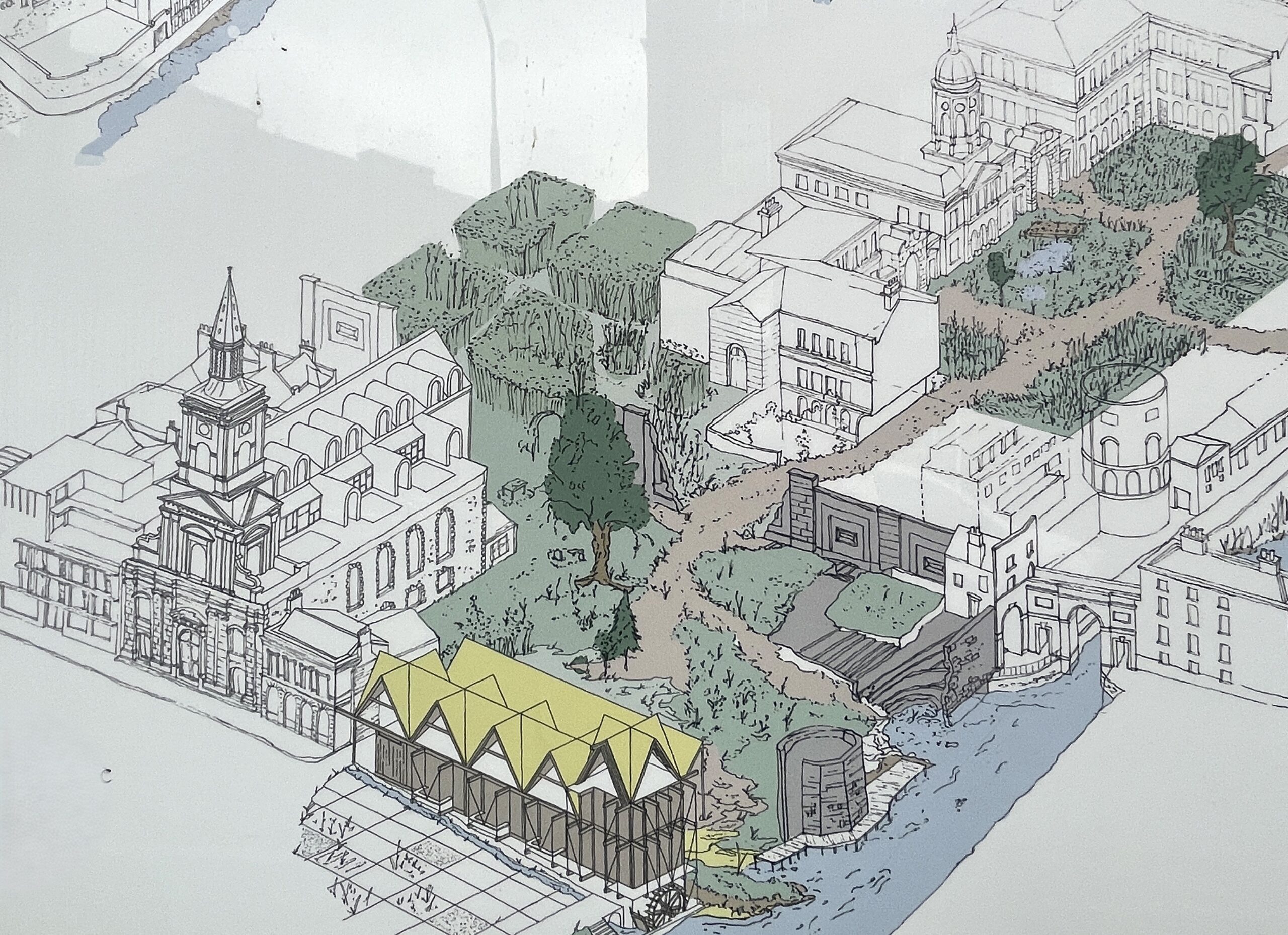
The beautiful illustrations evoke a site that has been at the heart of the city since Dublin was founded as a Viking port. A point where the water of the Poddle as it approaches the River Liffey was harnessed to power mills to serve the adjoining settlement. And images show how the area developed as the Viking settlement became an Anglo-Norman walled city. A sheep market here gave its name to Sheep Street, that in turn was corrupted to Ship Street – the name we know the street as today.
Another lost placename is Hoey’s Court. Developed in the 17thC by Sir James Hoey as an upmarket enclave for lawyers doing business in the nearby Castle. Hoey’s Court was famously the birthplace of Jonathan Swift, the celebrated satirist and Dean of Saint Patrick’s Cathedral.
Finally the project makes the case for a reimagining of this historic quarter by constructing a new Pole Mill using traditional timber construction methods. The image sets the building in a bucolic landscape that merges the re-exposing the Poddle with the various historic buildings now occupying the area. It’s fanciful but very original.
And the site in question is set to be redeveloped in coming years. After decades of protracted arguements around ownerships and titles and neglect of the site, the area now comes fully into the ownership of the City and is proposed to be reimagined as an historic centrepiece alongside the State’s premier ceremonial complex.


