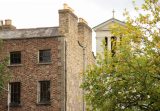
No.9 Merchant Quay are now set for a new life as Dublin City Council unveils plans to develop artists studios and cultural spaces.
14.02.26
Dublin City Arts Office has announced plans to redevelop three buildings on Merchant’s Quay into a new arts complex. Among the properties is No.9 – an 18thC townhouse that was rescued from dereliction by Dublin Civic Trust in 1997, restored and subsquently used by Dublin City Council as offices. The building is now set for a new lease of life as part of a multi-use arts venue.
Sited in the most enviable position in Dublin, overlooking James Gandon’s Four Courts masterpiece on Inns Quay, is an unassuming city mansion – No.9 Merchant’s Quay. No.9, which straddles four bays along the quay-front, cloaks a deeper rarity – namely, two entirely separate houses that were conjoined during the 18th century. Rarer still is the antiquity of one of the houses, which likely dates to the late 17th or early 18th centuries, and a surviving boat jetty that provides subterranean access to the Liffey.
Merchant’s Quay on the south bank of the Liffey was sited at the centre of the medieval city adjacent to Wood Quay and the trading heart of the city. It has been synonymous with the Franciscan religious order since the 1600s, originally founded in Dublin around the year 1230 before its friars abandoned the city in the 1540s under the Dissolution of the Monasteries. A new friary was built on adjacent Cook Street in 1615, followed by a new church erected in 1749, and by the present church on Merchant’s Quay which was begun in 1834 and completed in its present form in 1938.
Like many Catholic religious houses, the friary and church was positioned in the middle of the urban block of Merchant’s Quay, Winetavern Street and Cook Street, bounded by houses and trading premises on all sides. By the 18th century, the block was densely developed with houses such as No.9 providing the curtilage to the ecclesiastical complex within.
Merchant’s Quay on the south bank of the Liffey was sited at the centre of the medieval city adjacent to Wood Quay and the trading heart of the city. It has been synonymous with the Franciscan religious order since the 1600s, originally founded in Dublin around the year 1230 before its friars abandoned the city in the 1540s under the Dissolution of the Monasteries. A new friary was built on adjacent Cook Street in 1615, followed by a new church erected in 1749, and by the present church on Merchant’s Quay which was begun in 1834 and completed in its present form in 1938.
Like many Catholic religious houses, the friary and church was positioned in the middle of the urban block of Merchant’s Quay, Winetavern Street and Cook Street, bounded by houses and trading premises on all sides. By the 18th century, the block was densely developed with houses such as Number 9 providing the curtilage to the ecclesiastical complex within.
By the late 20th century, No.9 was in an advanced stage of dereliction and in danger of being lost. Through the intervention of Dublin Civic Trust and the facilitation of the Franciscan Order and Dublin City Council, the house was secured and transformed over a two-year period.
In addition to the restoration, an archaeological excavation on this site took place in 2000. Initial excavation of infill rubble material, laid down in earlier times to raise the basement floors, revealed the existence of a south-north-sloping slipway on the western side of the basement of the existing house. Further excavations unveiled a water channel or drain, two quay walls and oak timber remains. Artefacts retrieved from the basement consisted mainly of 18th and 19th century pottery shards, clay pipe remains and glass fragments.
Completed in 1999, the restored building was subsquently used as offices by Dublin City Council, until 2022, when it was vacated.
The City Council is now proposing to develop No.9, and the adjoining No.8 – which was formerly owned by the Franciscans as their publications office – as well as the 1960s St Anthony’s Hall to the rear, as a new creative and cultural space. 20 artist studios are proposed, while the Hall will be reconfigured and upgraded to create a new multi-purpose space for performance, wellbeing uses and exhibitions. The main entrance to the complex would be from the adjoining ‘Skippers Alley’ laneway, which also run to the rear of Adam & Eve Church.
Text from www.dublincivictrust.ie. Main image Dublin Civic Trust.


